
where the chickadees land
an essay on attention and creativity
Some time ago when I was studying transformative learning, I was introduced to the work of Humberto Maturana (a Chilean biologist/neuroscientist best known for his work on cognition, autopoiesis and systems theory). As you may have gathered already, his work continues to underpin my creative work and my research (I’m an autodidact, I am perpetually pulled towards new fields of inquiry).
Maturana proposed that we do not exist as isolated beings observing a separate world from a distance, but as organisms continuously shaped through relationship with our environments.
A flicker of movement at the edge of the window catches your eye. You turn and see a chickadee land at the feeder and peck through the seeds. The kettle is coming to a boil, a distinct hum in the background and the buzz of an unread text message still lingers in your mind. The ordinary pressures of your human life are still present in your field, the dishwasher needs to be emptied, it’s 9:07 and you need to be at work in 40 minutes. The chickadee tilts its head and glances towards the window and you wonder, can he see me through the glass? Am I shaping his field of awareness the way that he is shaping mine?
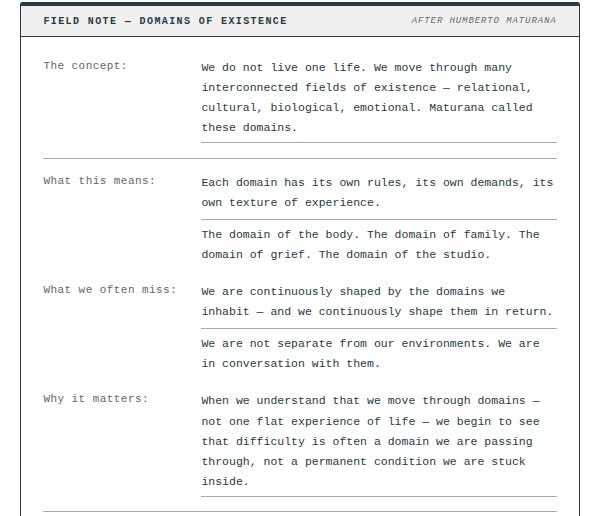
This is the strange reciprocity of living systems. Nothing alive exists in isolation, we are connected in our domains of experience and attention.
We move through interconnected domains of existence: biological, emotional, cultural, relational. Each domain carries its own textures, demands, rhythms, and possibilities, and we are constantly participating in their formation while they shape us in return.
I think about this often in ordinary life.
A dishwasher stops working. A difficult phone call changes the emotional terrain of the week. A medical result arrives or grief resurfaces unexpectedly. Something shifts beneath our feet, and suddenly the domain we were inhabiting reorganizes itself around us. What felt manageable yesterday suddenly feels unfamiliar today.
It can be tempting in these moments to believe we are trapped inside a permanent condition, tempting to submit to the idea that difficulty itself is the entirety of our lives.
It is in this place that creativity has taken residence as a way of reorienting to myself and reorganizing around my experience within the domains I inhabit.
My creative work is a relational practice that allows me (the human being) to remain present within changing conditions without being consumed by them entirely.
We are living systems, we are self-organzing, self-maintaining and capable of resilience and regeneration. A living system survives challenging conditions by continually adapting, responding and reorganizing (so let go of that need to control everything you experience. Spoiler alert? You can’t).
When the chickadees land at the bird feeder in the backyard, they reshape my attention. I pause while washing dishes to watch them move between branches. My nervous system softens, the emotional texture of the morning shifts, I take a deeper breath. The birds arrival changes the domain of my attention simply by moving and existing. Later, I’ll write about the birds and what they remind me of, and the chickadee shapes my memories, my reflections (and this essay).
When I speak about an ecology of attention, I am talking about precisely this experience with the chickadee and my attention: We are not separate observers standing outside the living world. We participate in recursive relationships, shaping the environments that shape us.
The world enters us continuously through sound, memory, weather, grief, beauty and the ordinary mundane takes of each domain. What we attend to becomes part of our own living architecture.
And here is where my creative works matters so deeply to me. It is one way of consciously participating in that relationship between domains, between the environment, the living systems we inhabit. It is one of the ways we can remain responsive to the changing domains of existence.
In moments of change or grief, a poem, a collage, a doodle even, allow us to remain in relationship with life while it is still unfolding.
Creativity becomes a way of metabolizing experience rather than escaping it. It is a way of witnessing our own existence within changing relational fields without collapsing beneath them.
I do not make art because my life is easy and peaceful at all times, I make art because it is not steady or full of ease.
What creativity offers me is continued presence and a way of remaining in the terrain I’m navigating without getting lost in it.
When the terrain shifts beneath you and you don’t quite know where you’ll end up, you can reach for the materials. A pen. Paper. A paintbrush. A notebook to doodle in. Flowers to arrange or cookies to bake. Not because making something will fix what is broken but because the act of making offers a way to keep moving in spite of everything.
When I turn to creative practice at any point, I find I’m able to enter a different state of mind. The heaviness I might be feeling finds its way into the words, across the paper. It moves through me and takes form outside of me, and something shifts inside, allowing me to keep moving.
You can think about this the way we think about living systems.
A living system (a forest, a pond, your own body) does not require ideal conditions to continue. It responds to what is present and reorganizes: it finds new pathways and sustains itself through continuous processes and the relationships between different parts of the system.
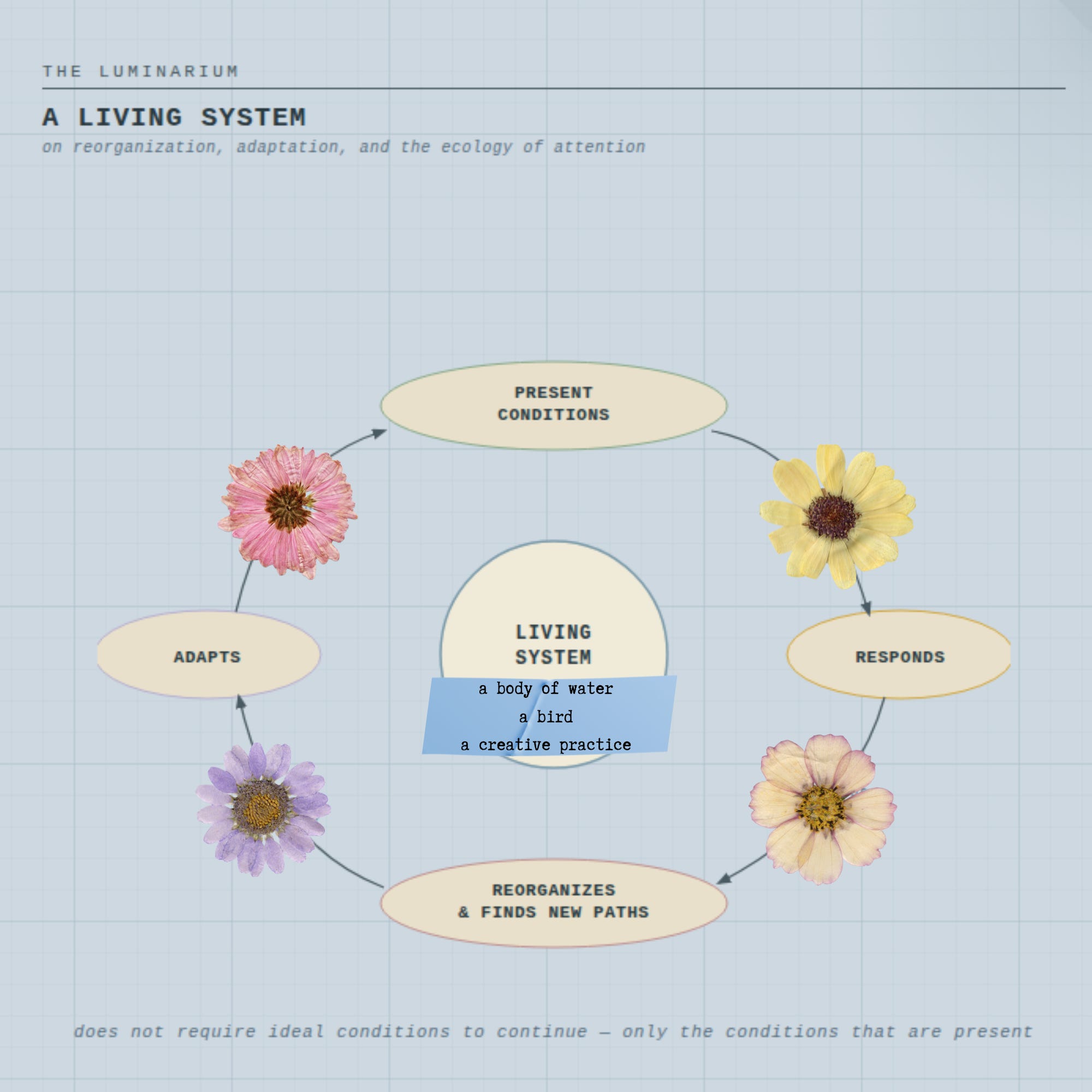
When creativity is embedded in a life as a habitual practice, it begins to sustain itself the same way an ecosystem does. One piece leads to another. One idea generates the next. One creative process allows you to set aside weight in order to reorganize around what you are experiencing within the domain you are living in. You put something down, walk away, return to it. You see something you didn’t see before. You return to the work and uncover a new direction, a path that wasn’t visible until you’d worked with it for a while.
There is no predetermined endpoint, only your attention moving through the creative work, keeping the system alive. And in turn, this creative system is helping you to reorganize your order of living. This is a cyclical process where output becomes input. Input becomes output. New perception generates new meaning, new work, new experiences, new feelings. The work you made last year informs the work you are making now, as much as who you were last year informs who you are now — and continues to inform the work and the living you haven’t even imagined yet.
The whole system is sustained by one thing: your continued attention to it. Your attention to your own living. Your attention to your creative work.
This isn’t about finding perfect conditions or creating the ideal environment to exist in. It is simply about responding and reorganizing to what exists in each domain, and allowing creativity to be a way your living system finds new pathways through difficult terrain.
So whatever domain you are moving through right now, whatever weight you are carrying, whatever terrain you are crossing, my invitation to you is simple:
Make something. Not because it will fix anything or because the outcome will be changed. Make something, write something, draw something - because the act of making is itself a form of living. A recursive way of remaining present even inside difficulty. A way of reorganizing your system that doesn’t ask you to be okay first.
It just asks you to be here.